Call queues and skills-based routing in Quebec
A queue does not create availability. What skills-based routing does, what a waiting caller needs to hear, and the point where a queue becomes a symptom.
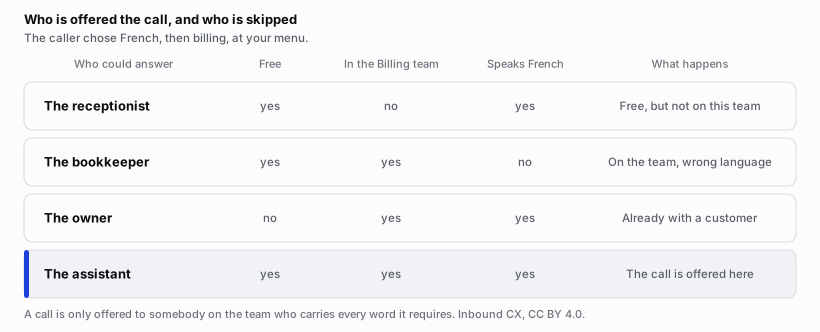
A call is only offered to somebody who is on the team and carries every word that team requires, which is why the first free person is not always the one who rings.
Reuse this figure anywhere, including commercially, with credit to Inbound CX and a link back to this page. CC BY 4.0.
A queue puts calls in order while agents free up. Skills-based routing decides who gets which call instead of whoever is next. Neither creates staff: a queue does not fix being short-handed, it makes it visible.
Search this in French and you land on pages written for France: Axialys, 3CX, jobphoning. The mechanics carry over; the Quebec context is written nowhere.
What does skills-based routing actually mean?
A call does not arrive at "the queue". It arrives at the set of agents holding a given attribute.
The most useful attribute in Quebec is not technical: it is language. A caller who chose service in French at the menu should not land with someone who has to transfer them. That is skills-based routing, and in many cases it is also a service obligation. See Law 96 and your phone system.
Other attributes come after: product, seniority, named accounts. Start with one. A six-dimension skills matrix built before anyone has watched real traffic routes badly, and nobody can say why.
Waiting has to tell the caller something
Silence is what makes people hang up, not duration. A caller who knows they are third waits longer than a caller who knows nothing.
Two blocks exist for this in the flow builder: Announce wait time and Offer a callback. The second is the most under-used of the set. The caller keeps their place without keeping the line, and your queue stops measuring how patient people are. How the callback works end to end, from the caller’s side, is in missed calls while everyone is busy.
Hold music matters too, and in Quebec it is not purely an aesthetic choice: the Charter has something to say about what plays. Hold music is included: the standard music plays unless you upload your own audio, and it adds nothing to the published price of a seat.
When the queue is the symptom
A queue that grows at the same hour every day is not a configuration problem. It is a schedule.
Before adding rules, check whether the Tuesday-10am overflow is solved by one more person on Tuesday at 10am. Routing tools are excellent at distributing capacity that exists and useless at inventing it.
What we do, and what we do not
Inbound CX does named queues, skills-based routing, in-queue flows and one flow per number; the customer-facing version of that is the teams and waiting page. The builder has 28 block types, and queues assemble alongside business hours and menus.
What we do not do: no shift scheduling, and no rota built for you; the staffing forecast on the Business plan is the half that exists. No multichannel contact floor either. On the Pro and Business plans a supervisor can listen to a live call, speak only to the agent, or join it, which our recording policy page sets out. If you are pricing “call centre software” for five people, read this first.
For what happens to a call once someone picks it up, see assisted transfer, hold and conference, and why the transfer is the part that breaks for the reason it goes wrong elsewhere.
Questions people ask
- What happens when everyone is already on a call?
- The caller stops hearing ringing and starts waiting. They get your hold music, roughly how long the wait is, and the offer to press 1 and be rung back instead of holding. If nobody has taken the call within thirty seconds it leaves the wait and follows the branch you set: voicemail, another team, or a message and a goodbye.
- What does skills-based routing actually mean?
- Each person carries a short list of words describing what they can handle, such as french or billing, and each team names the words it requires. A call is only offered to somebody who is in the team and carries every word that team asks for. There are no levels and no catalogue to pick from: the words are ones you invent.
- Can I make sure a French-speaking caller reaches somebody who speaks French?
- Yes. Write french on the people who speak it, and require it on the team the French option of your menu points at. Somebody without that word is never offered the call, so the caller does not have to be transferred a second time.
- How many teams can I have?
- As many as you name. A team is a rule rather than a place, so adding a fourth or a fifth is a setting you save, not a project. A team created on a Tuesday afternoon behaves exactly like one that has been running for a year.
- Does Inbound CX tell me how many callers are waiting?
- It reports how many are waiting and how long the longest has waited for your business as a whole, not per team. With one team those are the same number. With three busy teams it is an average across all of them, and the wait a caller hears is measured the same way.
Key takeaways
- A queue puts calls in order but adds no staff, so it makes being short-handed visible rather than fixing it.
- Skills-based routing offers a call only to people who can handle it, and in Quebec the most useful skill is language.
- Start with one skill, because a detailed skills matrix built before you have watched real calls routes badly.
- Silence is what makes callers hang up, so tell them roughly how long the wait is or offer to call them back.
- If the queue grows at the same hour every day, check whether one more person at that hour solves it before adding rules.
Ask us about your own phone line
If calls ring out while everyone is with a customer, tell us how many people answer and what kinds of call come in, and we will set the teams up with you.
A free tool for this, in your browser: the Erlang C calculator.
Talk to us